If you have eaten curd and treacle anywhere on the south coast, buffalo milk curd with a thick, dark, faintly smoky syrup drizzled over the top, you have already tasted kithul treacle. Almost nobody who eats it knows where it actually comes from, or what it takes to get a bottle of it onto the table.
Kithul treacle is tapped from the flower of the kithul palm, also called the fishtail palm, in villages scattered through the forested hills behind Galle, many of them close to Kanneliya and Deniyaya. It is a genuinely dangerous, highly skilled trade, passed down within families, and one of the most distinctive pieces of local food culture on this side of the island. Most visitors taste the syrup without ever knowing the tree, or the person who climbed it.
If you are wondering what kithul treacle actually is, how it is made, and whether you can see the process yourself, this guide should help.
What is kithul treacle?
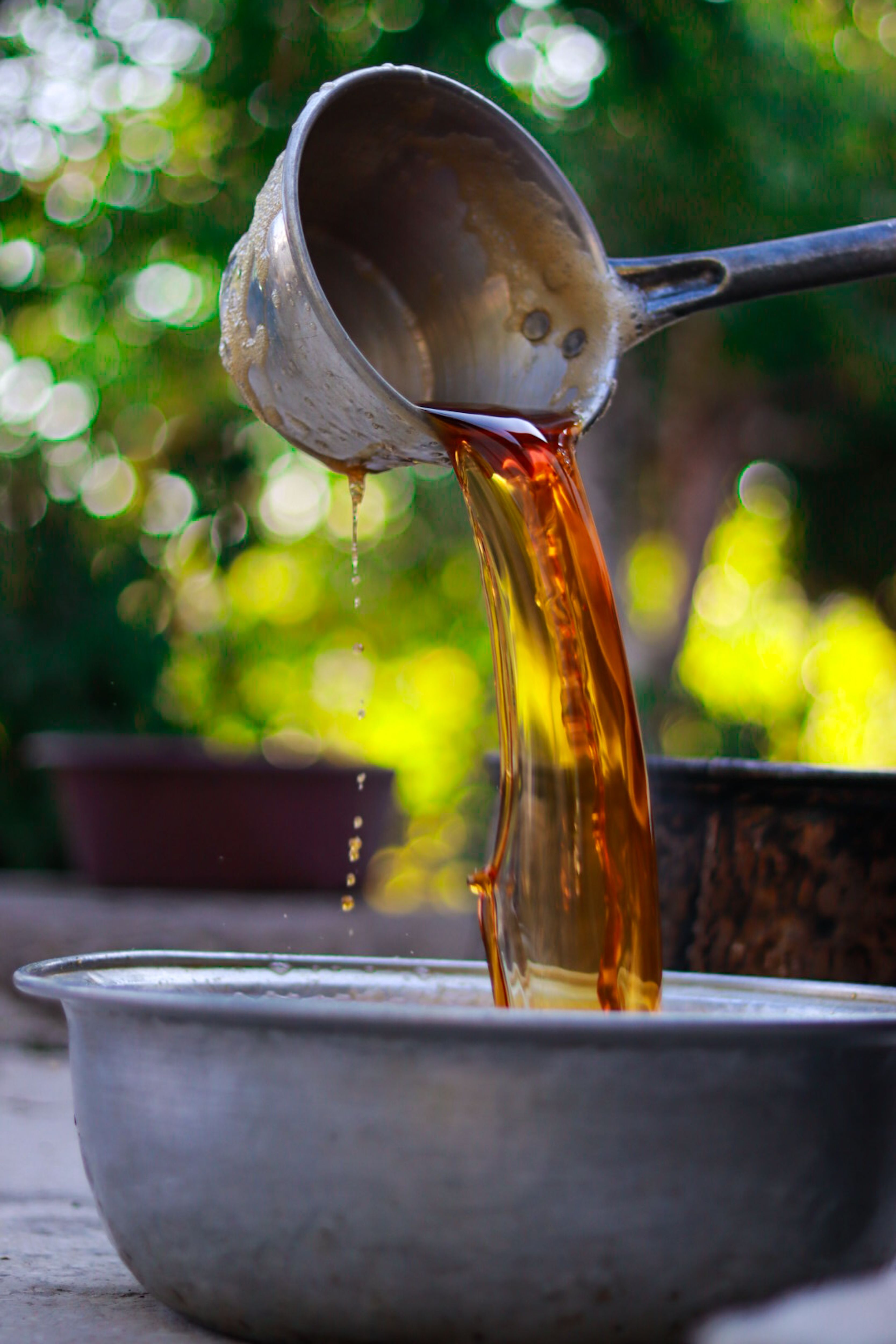
Kithul treacle is a natural syrup made from the sap of the kithul palm's flower, boiled down over an open fire until it thickens into a dark, honey-like syrup. Boiled further and poured into moulds, traditionally made from coconut shells, it sets into blocks of jaggery, a solid palm sugar.
The kithul palm, Caryota urens, is also called the fishtail palm for the distinctive shape of its leaves. Sri Lankans have tapped it for its sap for centuries, and the resulting treacle carries a genuinely different flavour from the syrups most visitors are used to, earthy, smoky, and less aggressively sweet than refined sugar syrups.
How is kithul treacle actually made?
The process starts long before the syrup itself, with the sap.
Tappers, almost always from families who have done this work for generations, climb kithul palms that can reach 40 metres in height, using nothing more than a rope and years of practised balance. At the base of the flower cluster, they make a precise, sharp cut, then tie a pot or jute sack beneath it to collect the sap as it trickles out over the following hours.
The fresh sap is mildly alcoholic and known locally as toddy, drunk on its own by some, though most of it is destined for the fire rather than the glass. Filtered and boiled down slowly over an open wood fire, it gradually thickens into treacle. Boiled further still, it becomes jaggery, poured into moulds to set into solid blocks.
This is not a quick or especially profitable trade. The palms take years to mature before they can be tapped at all, the climbing itself carries genuine physical risk, and the whole process, from climbing to boiling, is time-consuming relative to what a bottle of treacle sells for. It survives largely because it has always been a family trade, and because demand for the real thing, rather than commercially blended imitations, has never really gone away.
Where does kithul treacle come from on the south coast?
The most significant production areas sit in the forested hill villages behind Galle, particularly around Kanneliya and the wider area bordering Deniyaya and the Sinharaja rainforest belt. If you have already read our guide to Kanneliya, you are already close to some of the best-known kithul tapping villages in the south, since they sit within the same general forest region.
This is not commercial, factory-scale production. It is village-level work, often carried out by a handful of families in any given area, using methods that have changed very little over generations.
Can you actually watch kithul treacle being made?
Yes, in a few different ways, though this is not a formally ticketed attraction in most places.
Village walks organised through local guesthouses or tour operators are the most reliable way to see the full process, tapping, collecting and boiling, arranged in advance rather than something you can simply walk up to. Some operators specifically run village walks around Kanneliya covering kithul treacle and toddy production alongside other aspects of rural life in the area.
Asking locally around Kanneliya or Deniyaya can also turn up an informal visit, particularly if you already have a guide from a Kanneliya forest walk who may know a family willing to show you the process nearby.
Buying directly from a roadside seller on the roads leading toward Kanneliya or Deniyaya is the simplest way to at least taste and buy the product, even if you do not see the tapping itself.
Is a kithul treacle village visit worth it?
Yes, particularly if you are already planning a trip to Kanneliya and want to understand a genuine piece of rural livelihood in the same area, rather than treating the forest as the only reason to make the trip inland.
This is a low-key, unhurried kind of visit. There is no large facility, no gift shop, and no fixed schedule. What you get instead is a close look at a skilled, physically demanding trade that quietly supports entire rural communities in the hills behind Galle, and a direct connection to something you have very possibly already tasted without knowing it.
Treat it as an hour or two, ideally combined with a Kanneliya forest walk on the same day.
What can you buy or try?
Kithul treacle, the syrup itself, is the most common product, sold in bottles of varying sizes.
Kithul jaggery, the solid, set form, comes in blocks, traditionally moulded in coconut shells.
Kithul flour, made from the pith of the tree, is used in some traditional Sri Lankan sweets and puddings, though it is less commonly sold to visitors than the treacle or jaggery.
If you want to taste the way most Sri Lankans actually eat it, order curd and treacle at almost any local restaurant on the south coast, buffalo milk curd with kithul treacle drizzled over the top is one of the most traditional and widely loved desserts in the region.
How to get to the kithul treacle villages
The main producing areas sit inland from Galle, toward Kanneliya and Deniyaya.
From Galle
The Kanneliya area is around 30 to 40 kilometres from Galle, roughly 45 minutes to an hour by car or tuk tuk, the same route as a Kanneliya forest visit.
From Ahangama or Weligama
Generally an hour to an hour and 15 minutes by car, since this area sits inland behind Galle rather than directly on the coastal route.
Combining with Kanneliya
Since the tapping villages and the Kanneliya forest reserve sit in the same general area, the most efficient way to see both is a single day trip from Galle covering the forest walk in the morning and a village visit either before or after.
When is the best time to visit?
Kithul tapping and treacle boiling happen year-round rather than following a strict seasonal calendar, since it is tied to the palm's flowering cycle within individual trees rather than a single harvest season. That said, morning tends to be a more active time to catch tappers at work, since climbing is generally done earlier in the day.
What should you bring?
Keep it simple for a stop like this.
Bring cash if you want to buy treacle or jaggery directly, since these are typically small, informal sales rather than card-friendly transactions. Comfortable shoes are useful if the visit includes any walking through the village or surrounding land.
A few things I would know before visiting
Do not expect a polished, ticketed experience.
This is real rural livelihood, not a demonstration built for visitors, and arranging a visit generally means going through a local guesthouse, guide or tour operator rather than simply showing up.
Do not underestimate the skill and risk involved.
Climbing a 40 metre palm and working at height to tap the flower is genuinely dangerous work, carried out by people who have trained in it since childhood. A little respect for that goes a long way.
Do not assume all treacle sold roadside is the same quality.
Genuine, unadulterated kithul treacle can be harder to find than the name suggests, since demand outstrips supply and some commercial products blend in cheaper syrups. Buying directly from a known village source is the most reliable way to get the real thing.
Is a kithul treacle visit worth adding to your Sri Lanka itinerary?
I think so, particularly if you are already planning a trip to Kanneliya and want to understand more about the people living in the forested hills behind Galle, not just the trees and wildlife themselves.
This will not be the headline stop of your trip, and it does not need to be. What it offers is a genuine, close look at a skilled, family-run trade that has quietly shaped south coast food culture for centuries, and a direct answer to a question most visitors never think to ask about the treacle on their curd.
Taste it at the source.
Then order curd and treacle again, knowing exactly what went into it.
Frequently asked questions about kithul treacle
What is kithul treacle?
Kithul treacle is a natural syrup made from the sap of the kithul, or fishtail, palm flower, boiled down over an open fire until it thickens, a traditional Sri Lankan sweetener distinct from cane sugar syrups.
Where is kithul treacle made near Galle?
The main producing villages sit in the forested hills behind Galle, particularly around Kanneliya and the wider area bordering Deniyaya and the Sinharaja rainforest belt.
Can tourists watch kithul treacle being made?
Yes, generally through a village walk arranged with a local guesthouse or tour operator around Kanneliya or Deniyaya, or informally by asking locally in the area, rather than as a formal ticketed attraction.
What is the difference between kithul treacle and jaggery?
Treacle is the syrup form, boiled until thick and liquid. Jaggery is boiled further still and poured into moulds, setting into solid blocks of palm sugar.
Is kithul tapping dangerous?
Yes. Tappers climb palms up to 40 metres tall using rope and practised balance, a skill generally passed down within families over generations. It is considered genuinely risky, physically demanding work.
Where can I try kithul treacle in south Sri Lanka?
Curd and treacle, buffalo milk curd with kithul treacle drizzled on top, is a traditional dessert available at most local restaurants across the south coast, and is the easiest way to taste it without visiting a producing village directly.
Final thoughts
Most visitors to the south coast eat kithul treacle without ever knowing where it came from, a family up a 40 metre palm in the hills behind Galle, a fire burning slowly through the afternoon, sap turning to syrup one careful hour at a time.
You do not need to seek this out to enjoy the coast. But if you are already heading to Kanneliya, it costs very little extra to understand the trade that has quietly fed this part of Sri Lanka for generations.