Most people come to Weligama for the surf.
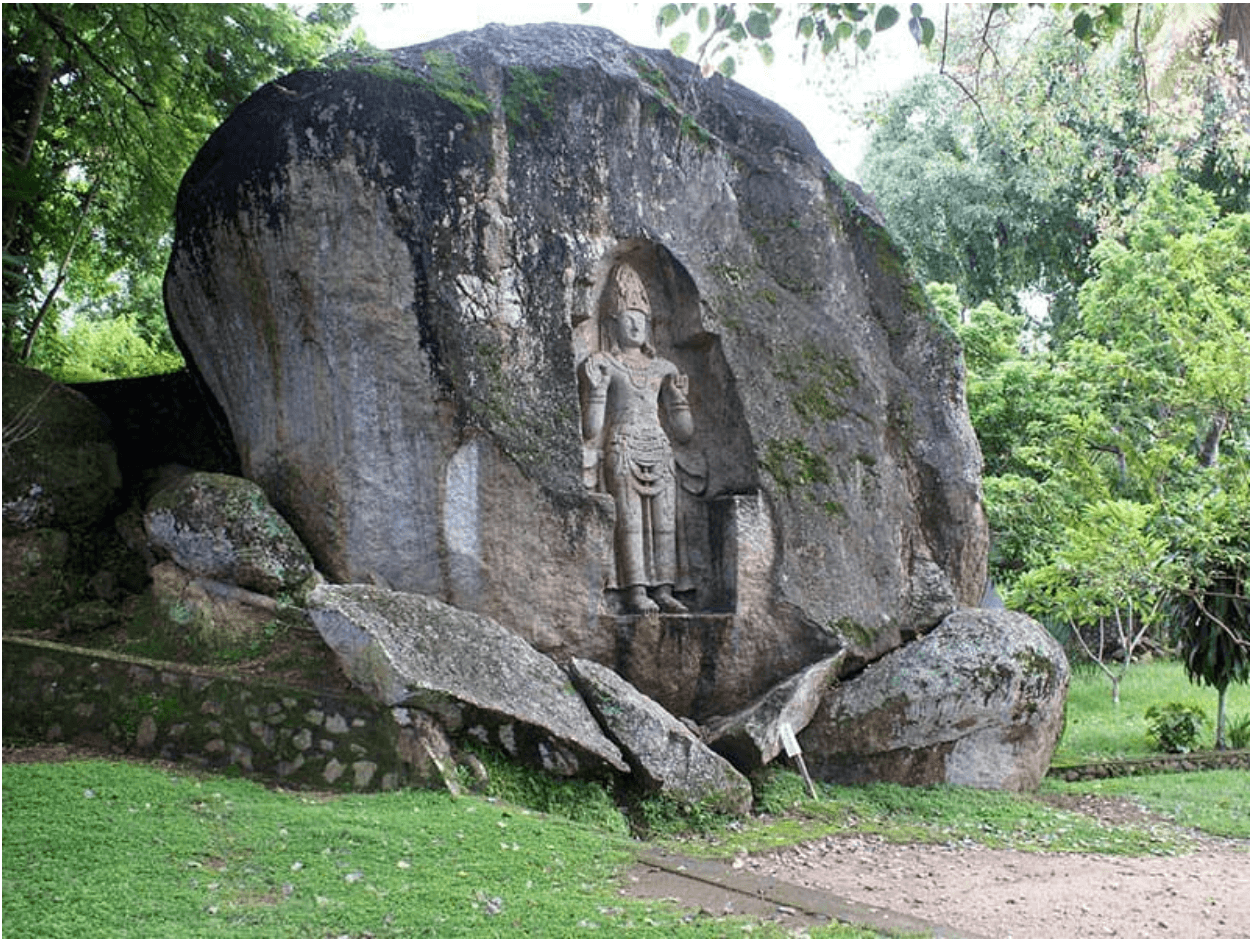
But a few minutes away from the beach, carved directly into a huge rock, is a nearly four-metre-high figure that has been standing here for well over a thousand years.
It's called Kushtarajagala, or roughly, the Rock of the Leper King.
And the story behind it is much stranger than you'd expect from something sitting quietly beside one of Sri Lanka's busiest surf towns.
What Is the Kushtarajagala Statue?
Kushtarajagala is an ancient rock-cut sculpture in Weligama, close to Agrabodhi Viharaya.
The figure stands about 3.83 metres high, carved into a niche in the face of a large boulder. The upper body is bare, while the lower half is dressed in a carved dhoti and decorative girdle. Look more carefully and you'll also see necklaces, bangles and an elaborate headdress.
It's an impressive piece of work.
But what's even more interesting is that nobody can tell you with complete certainty why it's here.
The most widely accepted archaeological interpretation is that the figure represents Avalokiteshvara, an important Bodhisattva in Mahayana Buddhism associated with compassion. Sri Lankan government material dates the sculpture stylistically to around the 6th or 7th century AD, while other researchers have proposed somewhat later dates.
Locally, though, there's another story.
And that's where the name Kushtarajagala comes from.
The Story of the Leper King
The story has been passed down in a few different versions.
One tells of a foreign prince or king suffering from a terrible skin disease who came to Weligama seeking help.
In Sinhala, kushta refers to a serious skin disease and has traditionally been associated with leprosy.
According to the legend, the sick royal came to the area around Agrabodhi Viharaya and eventually recovered.
How exactly he recovered depends on which version of the story you hear.
One says he made a vow connected to God Vishnu and promised an offering if his illness disappeared.
Another version says the cure involved coconut.
The story goes that he consumed coconut pulp or milk over a period of months and eventually recovered from his illness.
Before leaving Weligama, the grateful king supposedly had an image carved into the rock to remember what had happened.
And so it became known as Kushta Raja Gala.
The rock of the leper king.
It's a great story.
But it is a story.
There's no solid historical evidence proving that a sick king came here, was cured and commissioned the carving.
So Who Is Actually Carved Into the Rock?
This is where Kushtarajagala gets really interesting.
For years, the local legend encouraged people to see the carving as the mysterious king himself.
Archaeologists generally see something else.
The elaborate crown contains four small figures of Dhyani Buddha, while other features of the sculpture point toward Mahayana Buddhist iconography. Sri Lankan government material identifies the figure as Avalokiteshvara, also associated locally with Natha.
That makes Kushtarajagala particularly interesting because Sri Lanka today is overwhelmingly associated with Theravada Buddhism.
But Buddhist history here wasn't always that simple.
Mahayana traditions also existed on the island, and Kushtarajagala is considered an important surviving example of that part of Sri Lanka's Buddhist past.
There is even disagreement among scholars over the figure's exact identity. Some Buddhist sources have argued that the sculpture could represent Samantabhadra rather than Avalokiteshvara.
So more than a thousand years later, the statue is still giving people something to argue about.
I quite like that.
Look at the Statue Properly
It's easy to arrive, take a photo and leave two minutes later.
Don't.
Stand back for a minute and actually look at the carving.
The figure is much larger than it seems in photographs.
Look at the jewellery around the neck.
Then the arm ornaments.
The clothing.
And especially the headdress.
Those little details matter because they're part of how historians have tried to understand who the figure represents.
Then remember how old this thing potentially is.
Weligama outside is now full of surfboards, tuk-tuks, cafés, hotels and traffic.
This figure was already standing here centuries before any of that existed.
That's the part that gets me.
Kushtarajagala Shows You a Different Weligama
Weligama is usually sold to travellers through one thing.
Surfing.
And that's fair.
Weligama Bay is one of the easiest places in southern Sri Lanka to learn, and surfing has become a huge part of the town's modern identity.
But Weligama existed long before anyone arrived with a foam surfboard.
Sites like Kushtarajagala are a reminder of that.
This coastline has had Buddhist sites, trading connections, temples and settlements for centuries.
You don't have to suddenly turn your beach holiday into an archaeological expedition.
But if you're already staying in Weligama, spending a little time seeing this side of the town makes the place more interesting.
How to Visit Kushtarajagala in Weligama
Kushtarajagala is close to Agrabodhi Viharaya within Weligama, rather than being some complicated day trip outside town.
If you're staying around central Weligama or the bay, it's easy to include while exploring the area.
You don't need to dedicate half a day to it.
Think of it as a short cultural stop rather than a major attraction.
I'd combine it with a morning or afternoon around Weligama itself.
Surf early.
Get breakfast.
See Kushtarajagala.
Then continue with whatever you were planning.
Simple.
How Long Do You Need Here?
Around 20 to 30 minutes is plenty for most travellers.
There's no need to rush, but there's also no point pretending Kushtarajagala requires three hours.
The statue is the reason you're here.
Take your time looking at it, read a little about the history beforehand and then move on.
Knowing the story before arriving makes a huge difference.
Without it, you might just see an old carving in a rock.
With it, you're looking at a monument whose identity and origin people are still debating centuries later.
Is Kushtarajagala Worth Visiting?
If you're already in Weligama, yes.
Would I travel across southern Sri Lanka solely to see it?
Probably not.
But that's not really how I'd recommend experiencing places like this.
Kushtarajagala works because it's easy to add to a day you're already spending around Weligama.
And unlike another café or another beach viewpoint, it shows you something about the town that most visitors never really notice.
It's also refreshingly low-key.
You come.
You look.
You learn the strange story of a sick king, an ancient Bodhisattva and a carving that has somehow survived all this time.
Then ten minutes later, you're back in modern Weligama.
One Honest Note
You'll find very confident explanations online telling you exactly who built Kushtarajagala, exactly when it was carved and exactly who the figure represents.
The reality is less tidy.
Even published sources disagree on the dating. Sri Lankan government information places it around the 6th–7th centuries, other heritage sources commonly place it around the 7th–8th centuries, and some scholarship proposes later dates. There has also been debate about which Bodhisattva the carving depicts.
The Leper King story belongs to local folklore rather than established history.
And honestly, that uncertainty makes the place more interesting.
You have the archaeological evidence on one side.
A story passed down through generations on the other.
And a giant figure carved into a Weligama rock still sitting there between the two.
Don't Come to Weligama Just for the Surf
Learn to surf in the bay.
Eat somewhere local.
Head toward Midigama or Ahangama.
Watch the evening settle over Weligama Beach.
But give yourself half an hour for Kushtarajagala too.
The south of Sri Lanka gets much more interesting once you stop treating it as a collection of beaches.
Sometimes you only have to go a few streets inland to find something that's been here for more than a thousand years.
Planning a Few Days in Weligama?
Tell us when you're coming, how long you're staying and what you actually enjoy doing.
We'll put together a personalised Weligama itinerary with the beaches, surf spots, food, cultural stops and nearby places that make sense for your trip.