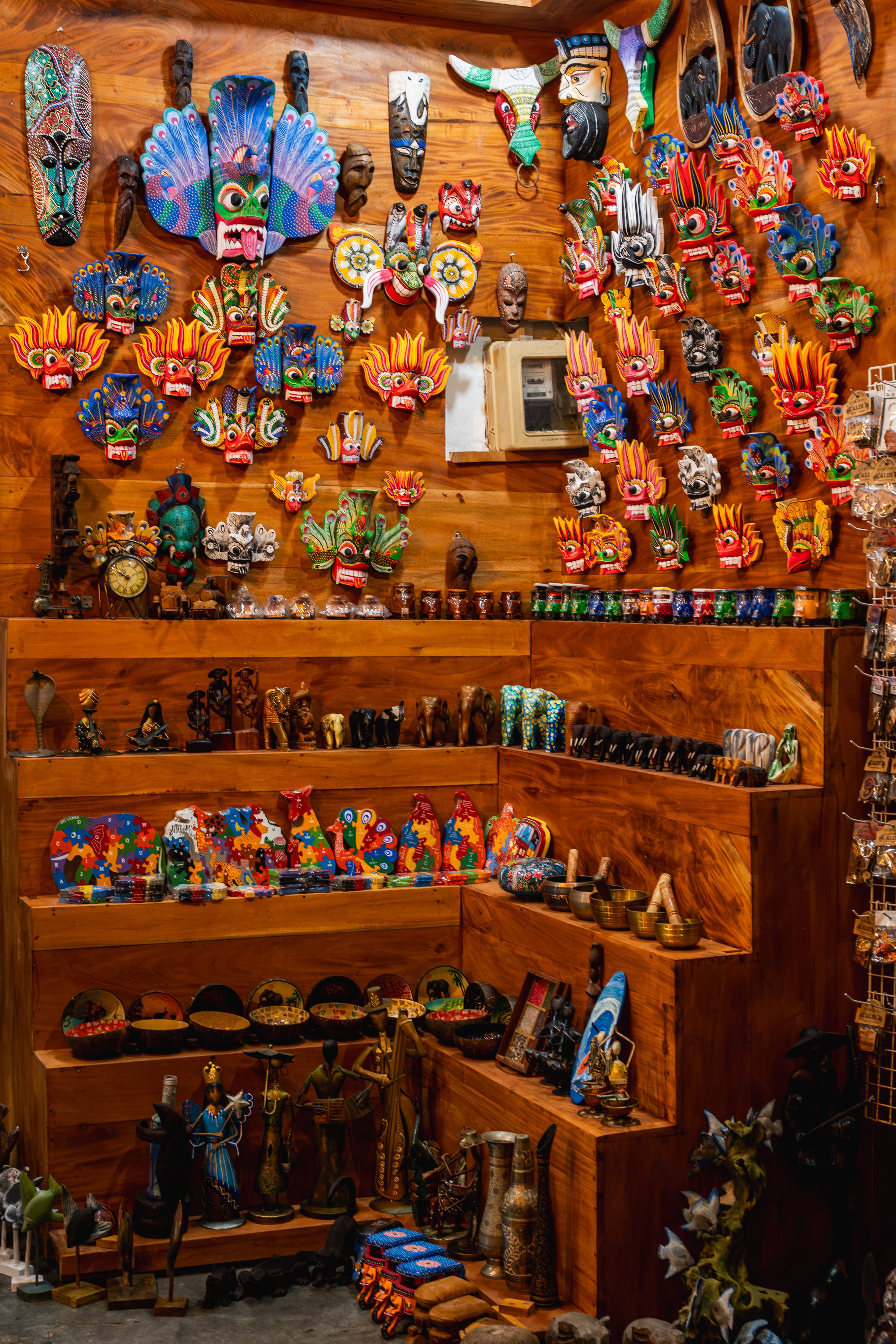
If you have visited the mask museums in Ambalangoda, or read our guide to the town, you have already seen the Sanni masks, wide-eyed, fanged, brightly painted wooden faces displayed alongside the more theatrical Kolam masks. What most visitors never learn is what each one actually represents, or why they were carved in the first place.
The Sanni masks are not decorative. Each one is tied to a specific demon, believed in traditional Sri Lankan folk belief to cause a specific illness, and each was carved for use in a real healing ritual, Sanni Yakuma, still occasionally performed today. This is the folklore behind the masks you have already seen.
What is Sanni Yakuma?
Sanni Yakuma is a traditional Sri Lankan exorcism and healing ritual, rooted in a folk belief system that predates and exists alongside Buddhist practice, in which illness is attributed to the influence of specific demons rather than purely physical causes. The ritual is performed by a specialist practitioner, historically an exorcist trained in the specific chants, movements and mask work the ceremony requires, intended to identify which demon is responsible for a patient's affliction and drive it out.
A full traditional ceremony is an elaborate, all-night affair, involving drumming, chanting, offerings, and a sequence of masked dance performances representing different demons in turn, historically held at the home of the afflicted person rather than a fixed venue. It sits within a broader tradition of low country dance and ritual found particularly in Sri Lanka's southern coastal belt, the same region responsible for the mask carving itself.
The eighteen Sanni demons
According to tradition, eighteen distinct Sanni demons, each represented by its own carved mask, are associated with eighteen specific ailments or afflictions. The exact list and details vary somewhat between different traditional accounts and regions, but the eighteen generally include demons associated with conditions such as blindness, deafness, madness, cholera, and various forms of fever and physical affliction, among others.
Each mask is carved with features intended to represent the specific affliction it governs, distorted or exaggerated facial features, particular colours, and specific expressions, all carrying meaning within the tradition rather than being purely decorative choices by the carver. A practitioner or exorcist trained in the tradition can identify what each mask represents at a glance, in the same way a doctor might recognise a diagnosis from a specific set of symptoms.
Mahasona, the graveyard demon
Among the most recognisable and feared figures in this broader demon tradition is Mahasona, whose name translates roughly to "great cemetery" or "great graveyard," reflecting his association with graveyards and death.
Mahasona is typically depicted with a bear's head, or a face combining bear and demonic features, and is associated in folklore with sudden death, particularly through accident or violence, and with causing fright-related illness in those who encounter him. Unlike the eighteen Sanni demons, who are each tied to a specific physical ailment, Mahasona sits somewhat apart in the tradition as a more singularly feared, standalone figure, often invoked or referenced in his own dedicated ritual context distinct from the broader Sanni Yakuma ceremony.
Various origin stories exist explaining how Mahasona came to have his distinctive bear-like head, generally involving a battle or confrontation with another figure in the broader mythology, though the details vary between tellings.
How does this connect to what you see in Ambalangoda?
If you have read our Ambalangoda guide, the masks displayed at the Ariyapala Mask Museum and similar workshops include genuine Sanni masks alongside the Kolam masks used in folk drama. The carving techniques are shared between both traditions, and Ambalangoda's workshops have historically served both, masks for storytelling performance and masks for genuine ritual healing use.
As covered in our guide to Kolam performance, the key distinction is purpose: Kolam masks serve narrative folk drama, while Sanni masks serve ritual healing practice specifically. Seeing them displayed together in a museum can blur that distinction, so it is worth remembering, as you look at any individual mask, which tradition it actually belongs to.
Is Sanni Yakuma still practised today?
To a limited degree, yes, though it is far less common than it once was, and modern medicine has understandably reduced reliance on this kind of ritual healing for most physical illness. Where it does continue, it tends to persist in more rural areas and within families who maintain the tradition specifically, sometimes performed in a shortened or adapted form rather than the full traditional all-night ceremony.
This is a genuine, living belief system for some communities, not simply a historical curiosity, and it is worth approaching with the same respect you would extend to any living religious or folk healing practice, rather than treating it purely as an entertaining local legend.
Can tourists see a Sanni Yakuma ceremony?
This is genuinely rare and should not be expected or actively sought out as a tourist activity in the way you might seek out a Kolam performance. Sanni Yakuma is a ritual performed for a specific person's healing, not a public entertainment, and treating it as a spectacle to be arranged for visitors would misunderstand and disrespect its actual purpose.
What is realistic, and appropriate, is learning about the tradition through the mask museums in Ambalangoda, where the masks themselves are displayed and explained, and through respectful conversation with practitioners or knowledgeable guides who are willing to discuss the folklore.
A few things worth knowing about this tradition
Do not treat Sanni masks as purely decorative or purely "spooky" tourist objects.
Each one represents a genuine, specific piece of traditional medical and religious belief, still meaningful to some communities today.
Do not confuse Sanni and Kolam masks, even though they are often displayed together.
One serves ritual healing, the other serves folk drama and storytelling. The carving techniques overlap, but the purposes are distinct.
Do not expect to witness or arrange a real Sanni Yakuma ceremony as a tourist activity.
This is a private healing ritual, not a public performance, and treating it as one would misunderstand its purpose.
Is this worth knowing before visiting Ambalangoda?
Yes, genuinely. Knowing the story behind the masks, Mahasona's graveyard associations, the eighteen specific afflictions the Sanni masks represent, transforms a museum visit from looking at interesting carved objects into understanding a real, historically significant system of folk belief that shaped how illness was understood on this coast for generations.
Frequently asked questions about Mahasona and the Sanni demons
What is Sanni Yakuma?
Sanni Yakuma is a traditional Sri Lankan exorcism and healing ritual in which illness is attributed to specific demons, performed by a trained practitioner using masked dance, chanting and ritual to identify and drive out the demon believed responsible.
Who is Mahasona?
Mahasona, meaning roughly "great graveyard," is a feared demon figure in Sri Lankan folklore, typically depicted with a bear's head, associated with graveyards, sudden death and fright-related illness.
What are the eighteen Sanni demons?
A set of eighteen demons in traditional Sri Lankan folk belief, each associated with a specific ailment or affliction, and each represented by its own carved mask used in the Sanni Yakuma healing ritual.
What is the difference between Sanni and Kolam masks?
Sanni masks are used in ritual healing practice, each representing a specific demon and affliction. Kolam masks are used in folk drama and storytelling, representing a wide cast of narrative characters. Both share carving traditions rooted in towns like Ambalangoda.
Is Sanni Yakuma still practised in Sri Lanka today?
To a limited degree, mostly in rural areas and within families maintaining the tradition, though it is far less common than in the past given the availability of modern medicine.
Final thoughts
The masks in Ambalangoda's museums are not just skilled woodwork, they are a genuine record of how illness, fear and healing were understood on this coast for generations, before modern medicine offered a different explanation.
Look at a Sanni mask a little longer next time you see one. Somewhere in that carved, exaggerated face is a specific fear, a specific ailment, and a specific attempt, however unfamiliar it may seem now, to heal it.