
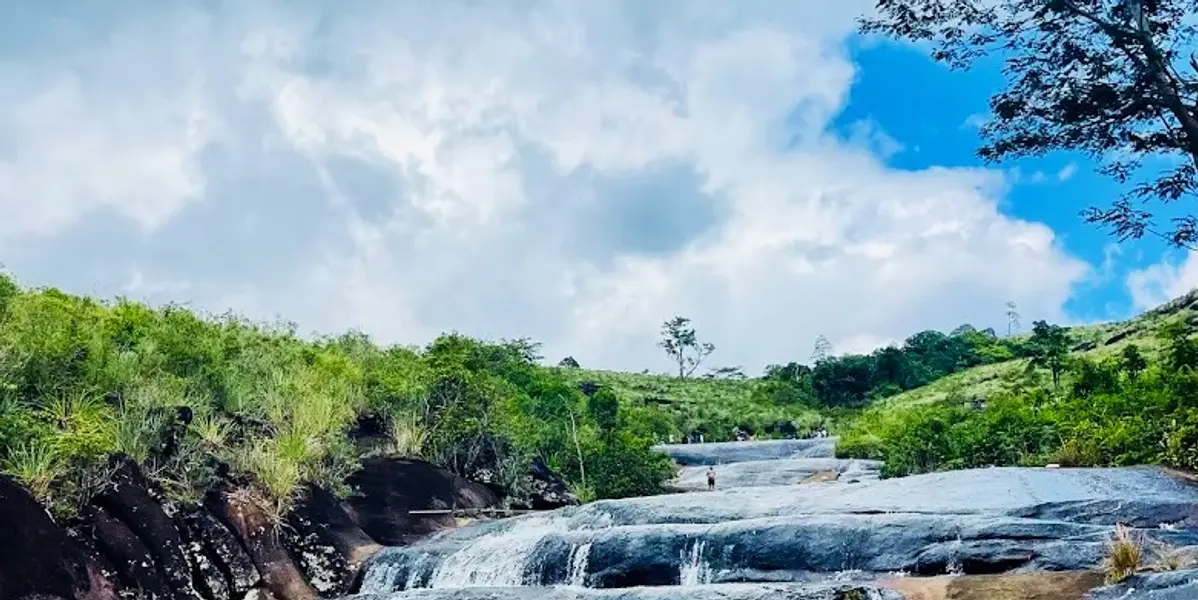
Most water parks come with a ticket office, queues and a lifeguard. Patna Sliding Rock has none of those. It is a broad sheet of smooth rock on a tea estate hillside, with a thin stream running down it and a shallow pool at the bottom, and it is just about the most fun you can have in fresh water in southern Sri Lanka.
That is Patna Sliding Rock, near Deniyaya in Matara district, on the edge of the Sinharaja rainforest. It is a long way from the beach towns, the last stretch is on foot, and you should treat the rock with respect. But if you want something different from the sea, it is hard to beat.
This guide covers what Patna Sliding Rock is, how to get there, whether it is safe, when to go, what to bring, and what to pair it with.
What is Patna Sliding Rock?
Patna Sliding Rock is a natural water slide. A river flows over several wide, gently sloping rocks, and the water has polished the surface smooth. At the end of each rock there is a shallow pool. Visitors climb up, sit in the thin sheet of water and slide down.
One description puts the main slide at roughly 15 metres. Another calls the experience a free water park. The water is cold, there are no waves, and most people, children included, slide again and again.
It is a relatively new discovery among travellers. It is known well by local families, but it is not on most foreign itineraries.
Where is Patna Sliding Rock?
It is in the Patna division, along Enasalwatta Road, in the Viharahena and Pallegama area near Deniyaya, in Matara district. It sits inside a tea estate, on the edge of the Sinharaja buffer zone, surrounded by tea plantations and patches of rainforest.
Deniyaya is the nearest town, about 4 km away, and is the practical base. One listing gives approximate coordinates of 6.335 N, 80.510 E. Search for "Patna Sliding Rock" in your maps app, and ask locally to confirm the last turn.
What is it like?
- The rock. A smooth, gently sloping surface with a thin film of water flowing over it. The upper rock is described as the safest section.
- The pools. Shallow pools collect the water at the end of each rock. They are not deep.
- The water. Cold, which is a pleasure after the walk.
- The flow. It changes. Visitors report that when the stream is low the rock can be hard to slide on, and when the rock is wet and the flow is strong it can get slippery.
- The crowd. Mostly Sri Lankan families and groups of friends. Go early and it is quieter.
Is Patna Sliding Rock safe?
It is fun, and it is also a natural rock face with no lifeguards. Please read this section.
- There is no formal safety infrastructure. No lifeguards, no railings, no first aid post. You are responsible for your own judgement.
- The nearest hospital is roughly 10 km away. A slip that causes a head or back injury is a serious matter here.
- Some landing areas have rock edges. One visitor warns that at certain places the landing water has rock edges, and the pools are not deep. Check the landing before you slide, and do not slide head-first.
- Slide sitting up, feet first, and keep your arms and legs under control.
- The rock is slippery when wet. Wear shoes with grip for climbing back up.
- Stay off it after heavy rain. The flow gets stronger and less predictable.
- Never go alone, and keep an eye on children at all times.
- Watch for leeches. The area is on the edge of Sinharaja, and leeches are common in wet weather.
If it does not feel right, skip it. The valley is worth the trip even if you only watch.
Best time to visit Patna Sliding Rock
Deniyaya is in Sri Lanka's wet zone, and rain can come in any month, so there is no guaranteed dry season here. One listing says May to September is the dry season, but that does not match the region's rainfall, so we would not rely on it.
What matters is the stream:
- Best: a steady, moderate flow, with the rock wet enough to slide on but not rushing.
- Not great: a trickle, which makes sliding difficult, or a swollen stream after heavy rain, which makes it dangerous and slippery.
- Time of day: go early in the morning, because the site gets busy later.
- Day of the week: weekdays are quieter than weekends and holidays.
Check the weather in Deniyaya the day before, and ask your host or driver whether the stream has been high.
Entry fee, parking and hours
A small fee is collected at or near the site for local upkeep. The amount is modest and changes, so confirm on arrival and bring small notes.
Visitors also mention that someone may ask for a small parking fee when you leave, if you park near the nursery or the tea collection centre. Agree the amount first. There are no formal opening hours, so treat it as a daylight visit.
How to get to Patna Sliding Rock
Deniyaya is far from the beach, so plan it as a long day or an overnight stay.
From Galle
Roughly 2 to 2.5 hours by car to Deniyaya, according to one listing. See our Galle guide for where to stay.
From Matara and Tangalle
From Tangalle, one listing gives 78 km and about 2 hours 42 minutes. From Matara, allow around 2 hours, which is our estimate. Our Matara guide and Tangalle guide cover those bases.
From Weligama, Mirissa and Hiriketiya
Allow roughly 2.5 to 3 hours each way. This is our own estimate, so check with your driver. It is a very long day, so start early or stay near Deniyaya.
From Colombo
Around 3 to 4 hours by road via the Southern Expressway and Akuressa.
The last stretch
The road to Deniyaya town is surfaced. The final kilometre to the rock is the hard part. The road through the Viharahena area is narrow, and visitors advise parking below the gate and walking about 1 km. A 4WD can go further, but most people walk. Wear closed shoes with grip.
By bus
Take a bus to Deniyaya, then a tuk tuk towards the Patna division, and walk the last part. Agree a return fare before you set off.
Our getting around guide covers private drivers and tuk tuks.
What to bring
- Shoes with grip for the walk and the rock. Trail sandals are fine.
- Quick-dry swimwear or clothes you do not mind getting wet.
- A dry bag and a spare change of clothes.
- A towel and plenty of water. There are no facilities at the site.
- Leech protection. Leech socks and repellent help in wet weather.
- Small cash for the entry and any parking fee.
- No valuables. Leave them locked up, and keep your phone in a waterproof pouch.
What to pair it with
Deniyaya is the southern gateway to Sinharaja, so a visit pairs naturally with a forest walk or other waterfalls.
- Tea estates. Several estates are listed within about 1 km. Respect the workers and ask before taking photos.
- Handapan Ella Falls. A waterfall listed about 4 km away.
- Sinharaja Forest Reserve. Read our Sinharaja guide for entry costs, mandatory guides, leeches and which gate to use.
- Neluwa Dowili Ella. A calmer swim with fenced bathing pools. See our Neluwa Dowili Ella guide.
- Kanneliya Rainforest Reserve. See our Kanneliya guide.
If you want to see the whole area properly, it works best as an overnight stay near Deniyaya.
Respect the estate
The rock is on a working tea estate. Please:
- Stay on the paths and do not cut through the tea.
- Take your rubbish with you.
- Be quiet and polite around workers, and do not photograph them without asking.
- Do not leave anything behind.
Is Patna Sliding Rock worth visiting?
Yes, if you are heading to Sinharaja or Deniyaya anyway, or you want a playful, genuinely local outdoor experience. It is a good day for families with older children and groups of friends.
Skip it if you only have a few days on the coast, if it has just rained heavily, if you do not like walking in leech country, or if you are not comfortable on wet rock. It is a very long drive for a short slide.
A few things we would know before visiting
Do not slide head-first.
Sit up and go feet first, and check the landing before you go.
Do not go after heavy rain.
The rock gets slippery and the flow becomes unpredictable.
Do not go alone.
There are no lifeguards, and the nearest hospital is about 10 km away.
Do not wear flip flops.
Shoes with grip matter for the walk and the climb back up.
Do not rely on a fixed fee.
Entry and parking charges change, so bring small notes.
Frequently asked questions about Patna Sliding Rock
What is Patna Sliding Rock?
A natural water slide near Deniyaya, where a stream runs down a smooth rock face into shallow pools.
Where is Patna Sliding Rock?
In the Patna division, near Viharahena and Pallegama, about 4 km from Deniyaya in Matara district, on a tea estate beside Sinharaja.
How long is the slide?
One description puts it at about 15 metres. It is a gentle slope of smooth rock, not a steep drop.
Is it safe for children?
Older children can enjoy it with close supervision, but there are no lifeguards. Check the landing, avoid it after heavy rain and never leave children alone.
Is there an entry fee?
A small fee is collected at or near the site. Confirm on arrival, and expect a small parking charge in some places.
How far is it from Galle?
Roughly 2 to 2.5 hours by car to Deniyaya.
Do I need a 4WD?
Not necessarily. The road to Deniyaya is surfaced, and most visitors park below the gate and walk about 1 km.
When is the best time to go?
Early morning on a weekday, when the stream is steady. Avoid heavy rain and very dry spells.
Are there leeches?
Yes, especially in wet weather. Wear leech socks and use repellent.
Final thoughts
The south coast is full of beaches. Patna Sliding Rock is one of the few places where the water is the ride, and where the best part of the day is climbing up and doing it again.
Go early, wear shoes with grip, slide sitting up and keep a respectful eye on the stream. Combine it with Sinharaja or another waterfall, and stay near Deniyaya if you can.
It is a long way from the beach, and it is worth it.

