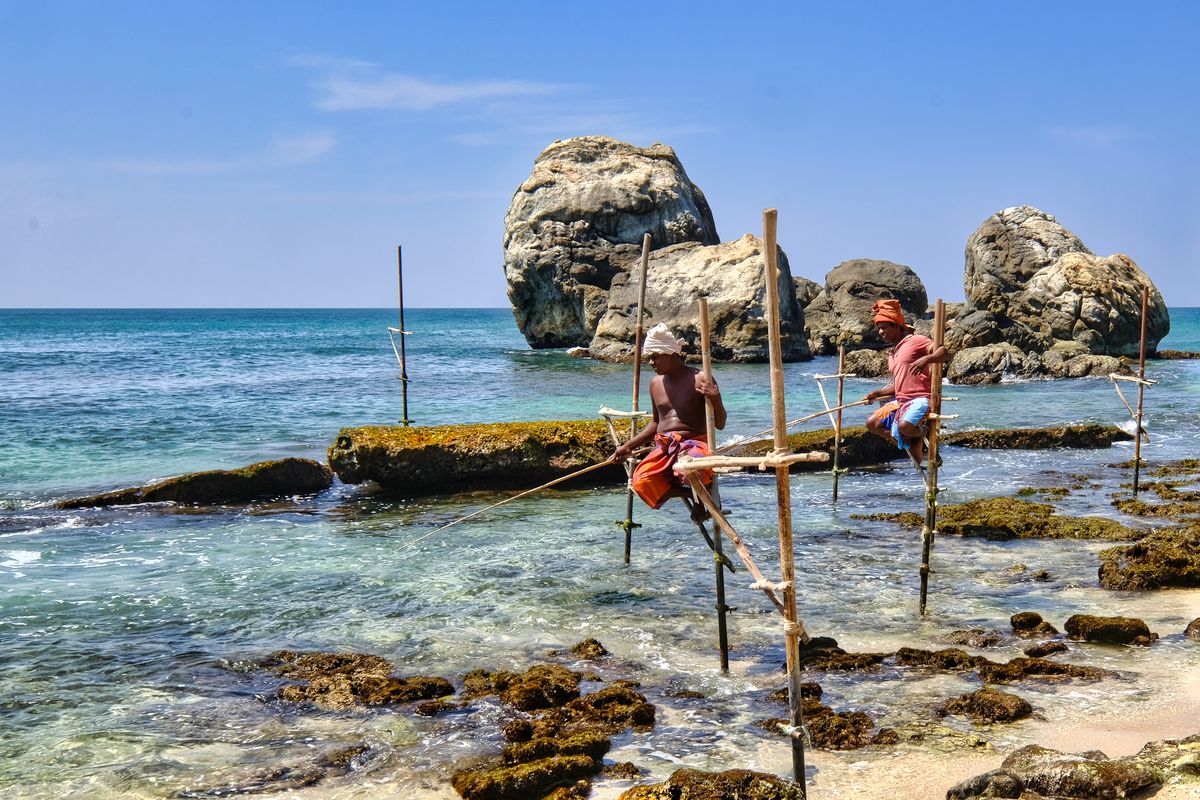
Stilt fishing is unique to this part of Sri Lanka. The practice involves balancing on a crossbar fixed to a single pole driven into the shallow seabed, fishing with a thin rod just above the waterline. It is found nowhere else in the world and is one of the most photographed images of the island. If you are planning to see it, here is what you actually need to know.
Where to see them. The stilt fishermen are concentrated on the stretch of coast between Koggala and Ahangama, roughly 15 to 20 kilometres south of Galle. The spots you are most likely to see working fishermen include the Koggala coast near the lake entrance, the beach stretches at Thalpe and Dalawella between Koggala and Unawatuna, and specific points along the Ahangama shoreline near Kabalana. Weligama sometimes has fishermen on stilts but the Koggala to Ahangama stretch is more reliable.
When they fish. Stilt fishermen go out in the early morning, typically from around 6am to 8am, and again in the late afternoon from around 4pm to 6pm. These are the times when the fish are feeding near the surface in the shallow water. Midday and the middle of the day are not fishing times. If you are driving past at noon and wondering where they are, they are at home.
The honest picture. Here is the thing that most travel blogs leave out: the number of men who stilt fish as their primary livelihood has declined significantly over the decades. The practice requires skill, patience, and conditions that produce enough fish to make it worth the effort. In some of the most touristy spots, fishermen have found that posing on the stilts for photographs and tips from tourists is more lucrative than the fishing itself. This does not make the photographs dishonest, but it is worth understanding what you are seeing.
The fishermen at the quieter stretches between Koggala and Ahangama, away from the main tourist viewpoints, are more likely to be genuinely fishing. They catch mostly small reef fish, ponyfish, and garfish in the shallow water. A successful morning on the stilts might produce a modest catch that is worth selling or taking home. The fishermen at the most photographed roadside spots near Unawatuna are more likely to be posing. Some will explicitly ask for payment for photographs. This is fine and normal — the photograph has value, and contributing to the person who provided it is appropriate. Just be clear about what the transaction is.
Photographing them. The best light for photographs is in the early morning from around 6am to 7am, when the sun is low, the sea is calm, and the fishermen are genuinely at work. The late afternoon session also produces good light. If you ask to photograph a fisherman and they agree, offer a tip of around 200 to 500 rupees. If they are clearly posing rather than fishing, a payment of 500 to 1,000 rupees for a photography session is reasonable.
The deeper question. Stilt fishing is a living tradition, not a heritage display. Some of the men who do it learned from their fathers and will teach their sons. Some do it a few times a week alongside other fishing methods. Whether it will survive another generation depends partly on whether it remains economically viable. Visiting, photographing respectfully, and tipping is one small way of making it so.