Thalpe sits between Unawatuna and Koggala, about 6 kilometres south of Galle along the coastal road. Most travellers drive through it on the way to Weligama or Mirissa without stopping. That is a mistake. Thalpe is what the stretch between Galle and Ahangama actually looks like when you get off the main road and slow down: a reef-lined shore, coral rock pools, stilt fishermen at dawn, and almost none of the commercial noise of Unawatuna a few kilometres north.
Getting there. From Galle, take any southbound bus toward Matara and ask to get off at Thalpe. It takes about 15 minutes and costs next to nothing. By tuk-tuk from Galle, expect around 400 to 600 rupees. From Weligama, you are coming back north and the journey takes about 20 minutes. There is no dramatic entrance or signposted beach path. You turn off the main road down a narrow lane and the coast appears.
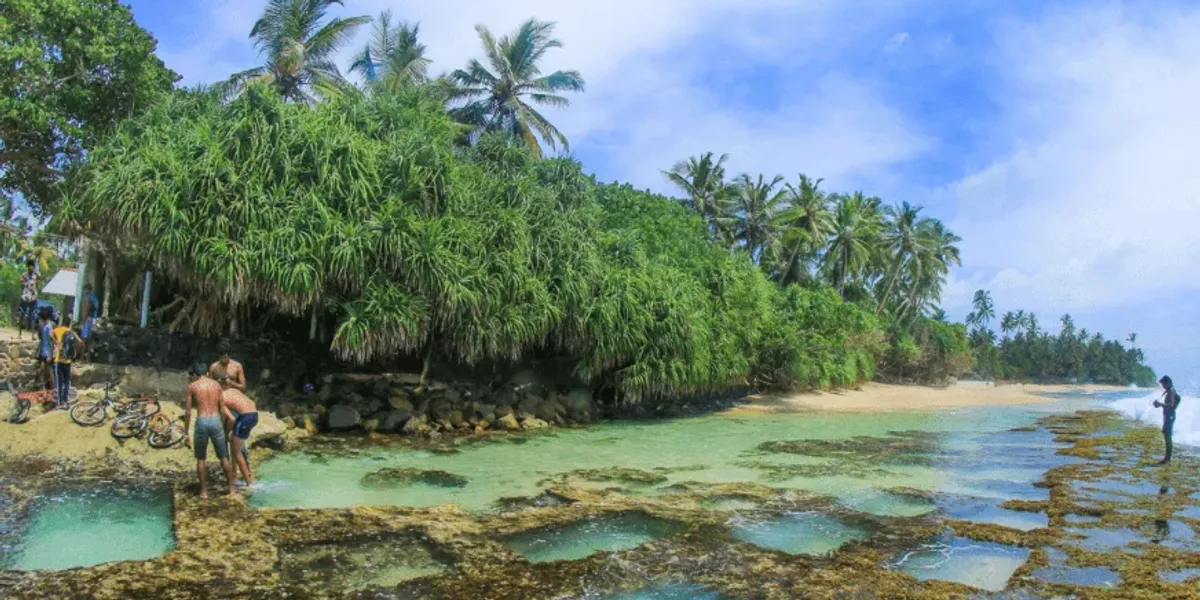
The rock pools. The most distinctive feature of Thalpe Beach is the grid of rectangular rock pools carved into the coral reef along the shoreline. These were not made for tourists. They are around 50 years old and were originally used by local fishermen to soak coconut husks, loosening the fibres for making coir rope. The pools fill with seawater at high tide and become calm, clear paddling pools that are particularly good for children or anyone who wants to cool off without swimming in open water. They are rough underfoot so bring sandals or water shoes. Go at high tide for the best water levels.
The stilt fishermen. Thalpe and the stretch through Koggala is one of the few remaining places on the coast where you can still see stilt fishermen in the early morning and late afternoon. The practice involves balancing on a crossbar fixed to a single pole driven into the seabed and fishing with a thin rod. It is unique to this stretch of the Sri Lankan coast. One honest note: some fishermen in the more touristy spots now pose for photographs rather than actively fishing. The fishermen at Thalpe tend to be more genuinely at work than those at the better-known Unawatuna viewpoints. If you photograph them, offer a small tip. It is the respectful thing to do.
The swimming. Thalpe is calm and clear, particularly in the dry season from November through April. The reef provides some protection from the open swell and the water is shallow enough close to shore to be comfortable for most swimmers. It is not as sheltered as Polhena near Matara but it is significantly quieter than Unawatuna, and on a weekday morning in the dry season you will sometimes have long stretches of it entirely to yourself.
Dalawella, just around the corner. A five-minute walk or one-minute tuk-tuk north of Thalpe is Dalawella Beach, home to one of the more photographed palm trees in Sri Lanka. A coconut palm leans almost horizontally over the water and a rope swing hangs from it, allowing you to swing out over the sea. The swing is run by Dream Cabana guesthouse and costs 200 to 500 rupees. It is not a secret, and in the late afternoon it attracts a small crowd for sunset. Go at 4pm on a weekday if you want your turn without queuing. Dalawella is also a reliable spot for sea turtle sightings close to shore, particularly in the early morning.
How long to spend here. Thalpe and Dalawella together are a half-day, not a full day. The right way to visit is as a morning trip from Galle: the rock pools and stilt fishermen in the early morning, a swim, lunch at one of the small restaurants along the coast road, and back to Galle by early afternoon. It combines well with a visit to Koggala Lake, which is about 10 minutes further south.