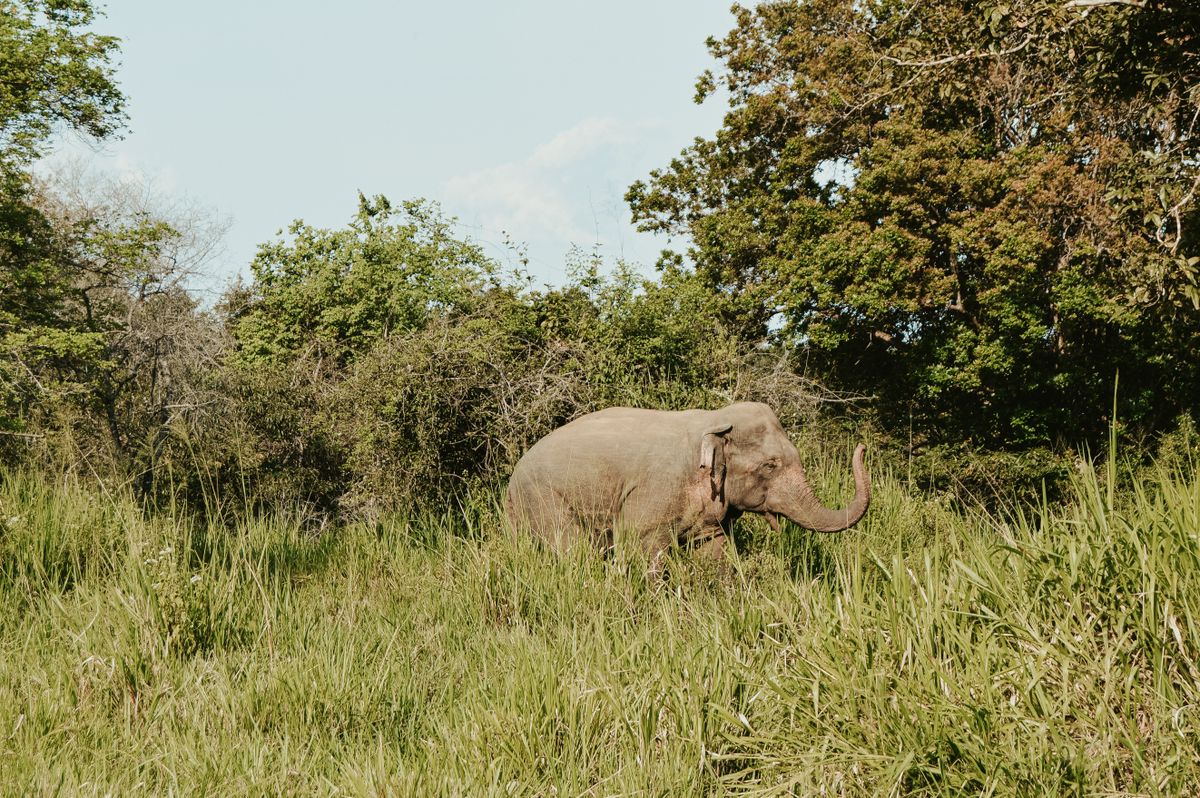
If seeing wild elephants is on your list, Udawalawe is the answer. Unlike Yala, where leopards and bears can require patience and luck, elephant sightings at Udawalawe are virtually guaranteed on every visit. The park has a resident population of around 600 elephants that do not migrate. On a typical morning safari, most visitors see multiple herds totalling 20 to 50 or more elephants in open grassland, close enough to photograph properly without a telephoto lens. Blank sightings — where you see no elephants at all — are extremely rare.
What Udawalawe is. The park was established in 1972 to provide habitat for wildlife displaced by the construction of the Uda Walawe dam. The reservoir created by the dam now draws elephants, water buffalo, and birds to its edges reliably throughout the year. The open grassland terrain, unlike the dense scrub forest of Yala, means the animals are visible from a distance. You can see them coming and track their movement across the plain. It is a completely different experience from a jungle safari and in many ways more accessible for first-time safari visitors.
What you will see. Wild elephants are the main event and the sightings are consistent year-round. Beyond elephants, you will typically see water buffalo, spotted deer, mugger crocodiles along the reservoir edges, peacocks, painted storks, and a wide variety of bird species. Leopards exist in the park but are rarely seen due to the open terrain offering less cover than Yala. Do not visit Udawalawe specifically for leopard sightings.
The Elephant Transit Home. Adjacent to the park, the Elephant Transit Home is a rehabilitation centre for orphaned elephant calves. Unlike elephant orphanages that keep animals in captivity permanently, the ETH rehabilitates young elephants and releases them back into Udawalawe National Park once they can survive independently. Feeding times for the baby elephants take place from a designated viewing platform at 9am, 12pm, 3pm, and 6pm. Watching baby elephants being bottle-fed milk by their caretakers is a different experience from the wild safari and worth combining with your park visit. There is a small entrance fee for the ETH. The 9am feeding works well before an afternoon safari, or the 3pm feeding after a morning one.
What it costs. The park entrance fee for foreign adults is approximately $42.50 USD including taxes as of 2026. Children aged 6 to 12 pay approximately $18 USD. Children under 6 enter free. A half-day jeep hire for up to 6 people costs $60 to $80 USD for the vehicle. For a couple, the total including entrance and shared jeep comes to roughly $50 to $60 USD per person. The park accepts Sri Lankan rupees only at the entrance counter, so bring enough cash in LKR.
When to go. Udawalawe can be visited year-round. The dry season from May to September is the best time for concentrated elephant sightings as waterholes shrink and herds gather at the reservoir. December through March is also excellent with good weather and visibility. The wettest months are October and November, though elephants remain visible even then.
Morning or afternoon safari. The morning safari starting at 6am is the most popular and recommended. Animals are active in the first two hours after the gate opens and the light is good for photography. Afternoon safaris starting around 2.30pm have fewer jeeps and offer beautiful sunset light over the reservoir. Both are worth doing if you have a second day.
Getting there from the south coast. Udawalawe sits about 2.5 to 3 hours from Mirissa, Weligama, or Tangalle by road. It works perfectly as a day trip from Hiriketiya or Tangalle, or as a stopover on the route between the south coast and Ella. The drive from Ella to Udawalawe takes around 2 hours. Many travellers do Udawalawe as a morning safari followed by a drive to the coast the same afternoon, which is an efficient use of a travel day and means you arrive at the beach with a full safari already done.
Book through your accommodation in Udawalawe or Ella rather than through a tout. Your guesthouse can arrange the jeep, driver, park entry logistics, and ETH timing as a package. No advance booking with the park authority is needed.