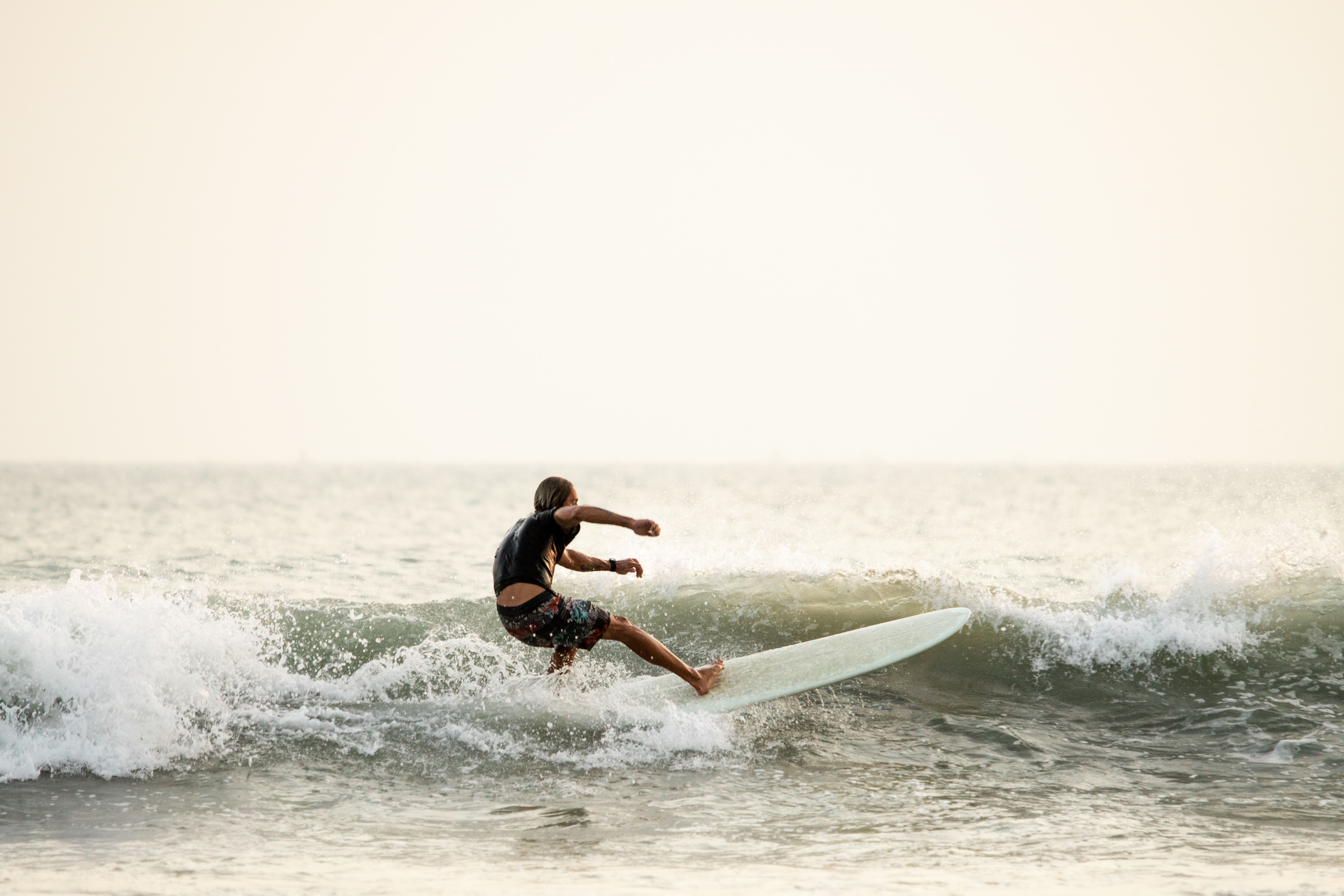
Weligama is the best place to learn to surf in Sri Lanka, and it is one of the better places to learn anywhere in Asia. The reason is the wave. The bay produces a long, slow, forgiving break across a wide stretch of sand. It is consistent enough to give you multiple chances in a single session and gentle enough that wiping out does not hurt. The combination of good conditions, an established surf school scene, and warm water makes it genuinely accessible for people who have never stood on a board before.
What to expect from your first lesson. A standard beginner lesson runs for two hours and includes a board, a leash, a rash guard, and a one-on-one or small group instructor. The first 20 to 30 minutes happen on the sand. You learn how to read the wave, how to pop up from lying to standing, where to position your feet, and what to do with your arms. Then you go in the water. The instructor pushes the board into the wave for you, tells you when to stand, and gradually hands over more control as the session progresses. Most people stand up on a wave on their first day. Most people also fall off more than they stand. Both things are normal.
How much it costs. Surf lessons in Weligama cost around 3,000 to 5,000 rupees for a two-hour session, which includes board rental and instruction. Board-only rental without a lesson is available from most surf shops and beach shacks for around 500 to 1,000 rupees per hour. For a second or third lesson, prices are often negotiable if you go back to the same school. Some schools offer multi-day packages that are better value than individual sessions.
When to go. The surf in Weligama is at its most consistent from October through April, when the south coast is in its dry season. The wave breaks well in this period and conditions are generally clean. From May onward, the southwest monsoon increases the swell size and the sea becomes less predictable, which is not ideal for absolute beginners. You can still surf in Weligama during the off season, but the conditions are better suited to intermediate surfers who can read a rougher wave.
What comes after your first lesson. Weligama works as a learning base for the first week. Once you can stand up consistently and start to read where the wave is breaking, the next step is to move to a more challenging wave. Hiriketiya has a left-hand break that suits surfers at the intermediate stage. Ahangama has several breaks of increasing difficulty at Kabalana, including The Rock for more advanced surfers. The surf spots guide on this blog covers all the main breaks on the coast and who they are suited to.
A practical note on boards. The boards used for beginners are large foam boards, sometimes called foamies or soft-tops. They are wide, stable, and float well. Do not try to progress to a smaller fibreglass board before you are consistently popping up on the foam board. Most people who rush this transition end up going backwards, not forwards.