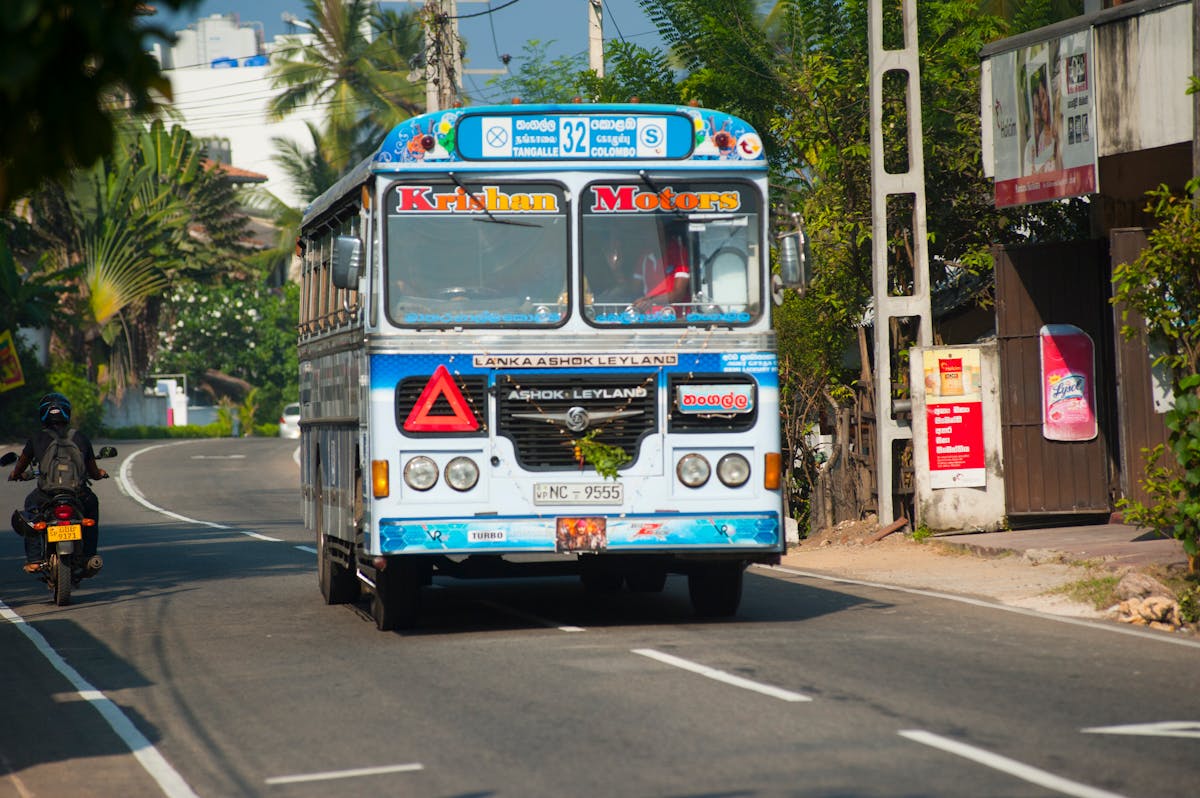
You hear the bus before you see it. First the horn, then a thumping Sinhala pop song, then the bus itself, painted in a dozen colours, bearing down on the road with a Buddha statue on the dashboard and a soft toy jellyfish swinging from the mirror.
If you travel by bus on the south coast, this is the norm. The music is loud, the decorations are lavish, and almost nobody on board seems to mind.
This guide covers why Sri Lankan private buses blast music, what the 2020 ban and playlist were about, what drivers say, and how to survive a bus ride with your ears and your sanity intact.
What is a Sri Lankan private bus like?
Private buses dominate Sri Lanka's roads. One estimate put the number at around 20,000, and they are the buses you are most likely to ride on the south coast. Travellers describe them as:
- Colourful. Painted in oranges, greens, blues and purples, and decorated inside too.
- Decorated to the driver's taste. Fake flowers, dangling soft toys, stickers, incense sticks and garlands.
- Religious. Buses typically carry pictures of the Buddha, often a small altar at the front with fresh flowers, and some drivers add Hindu or Christian imagery.
- Noisy. Not just the music. The horn is used constantly, and one writer describes bus drivers always keeping one hand on it.
- Fast and full. Conductors fit in as many passengers as possible, and drivers are famous for their confidence.
If you like the look of the decorations, you may also enjoy why tuk tuks have so many stickers.
Why do they play music so loud?
There is no single answer, but these are the reasons people give.
1. Drivers say it fights boredom
Some drivers have said that loud music helps them stay awake and avoid monotony on long routes. Not everyone agrees. One bus worker told a newspaper that loud music does not actually keep drivers awake.
2. Passengers like it
Researchers who studied bus culture say owners and drivers report that people check the audio-visual setup before booking, especially for group trips such as picnics and pilgrimages. Passengers ask for loud music, lights and video screens. For those trips, the music is part of the appeal.
3. It makes the bus stand out
Bus owners and drivers say the decorations and lights are partly to make the bus look "pretty" and attractive. Buses compete for passengers, and a lively bus is easy to spot.
4. It is part of the culture
Over time it has become a recognisable subculture, with its own styles, playlists and rituals, and for many people it is a normal part of daily life.
What kind of music is it?
Mostly Sinhala, Tamil and Hindi songs, often from low-budget movies. Many long-distance buses also show high-volume music videos on TVs, and some advertise "dual TVs". Not all of it is children-friendly, which is one reason the government stepped in.
The 2020 ban and the playlist
In January 2020 the National Transport Commission announced a ban on loud music and videos on private and state buses, after years of complaints. The rules came with two notable details:
- A free playlist of about 1,000 songs was offered to bus operators, in Sinhala, Tamil and Hindi, to be played at a reasonable volume. Reports differ on whether the list was compulsory or optional.
- The commission said passengers could complain, and listed a hotline, which was 1955 at the time. Check the current number before you rely on it.
Drivers' reactions were mixed. Some welcomed it, some said the old songs would put them to sleep, and others carried on playing their own mix. Some owners agreed to keep the volume to a more reasonable 60 to 80 decibels.
Years later, researchers still describe loud music and bright lights as part of the private bus subculture, so the rule has clearly not ended it. Expect to hear it.
Not every bus is loud
Intercity and air-conditioned buses are noticeably quieter, with less decoration and a more reserved atmosphere. If you want a calm ride on a long journey, they are usually the better option. State-run buses can also be quieter, though it varies.
Not just buses: the bread van that plays Für Elise
Sri Lankan roads have another famous musical vehicle. Mobile bread vendors, known as choon paan, use tuk tuks and vans that play a tinkling tune, and the tune is Beethoven's Für Elise. The idea began around the early 2000s, when the piece was a popular ringtone. A ban on loud music for these vehicles followed in 2017.
How to survive a Sri Lankan bus ride
- Choose an air-conditioned intercity bus for long trips. They are quieter and more comfortable.
- Bring earplugs or noise-cancelling headphones. This is the most reliable fix.
- Look at where the speakers are before you choose a seat.
- Travel light. Buses fill up fast, and luggage space is limited.
- Expect delays. Private buses stop often, and one traveller reports an average speed of around 35 km/h.
- Hold on. Drivers brake and accelerate hard, so grip a rail.
- Keep your valuables close in crowded buses.
Our guide to the coast without a car compares buses with trains, tuk tuks and scooters, and our Colombo to Mirissa and Weligama guide covers the longer bus journeys.
Should you complain?
If the music is truly unbearable, you can politely ask the conductor to turn it down, and many will. In most cases, other passengers do not mind, so a polite request is more likely to work than a complaint. For serious or repeated issues, the commission's hotline exists, though you should check the current number.
Is it worth taking a private bus?
Yes, at least once. It is cheap, it takes you into the middle of everyday life and it comes with a soundtrack. For a long trip with luggage, or if you are tired, a train, taxi or air-conditioned bus is easier.
Our Unofficial Rules guide has more on how things really work here.
A few things we would know before boarding
Do not expect a quiet ride on a private bus.
Bring earplugs.
Do not take a large bag if you can avoid it.
The aisles are narrow and the buses are crowded.
Do not stand near the door with your phone out.
Hold on and keep your valuables safe.
Do not assume the bus will leave on time.
It leaves when it is full.
Do not take it personally.
The music is not aimed at you. It is just how the bus works.
Frequently asked questions about Sri Lankan buses and music
Why do Sri Lankan buses play loud music?
Drivers say it helps with boredom, passengers on group trips ask for it, and it is part of a wider bus subculture of music, lights and decoration.
Is loud music banned on buses in Sri Lanka?
A ban on loud music and videos was announced in January 2020 for private and state buses, but loud music is still widely reported.
What music do buses play?
Mostly Sinhala, Tamil and Hindi songs, often from movies, and music videos on TV screens.
Why are Sri Lankan buses so colourful?
Owners and drivers say it is partly to make the bus attractive, and the interiors often reflect the driver's taste and religion.
Why do buses have Buddha statues?
Most carry images of the Buddha, often on a small altar at the front. Some drivers also display Hindu or Christian imagery.
Are all buses loud?
No. Intercity and air-conditioned buses are usually quieter and less decorated.
How can I avoid the noise?
Choose an air-conditioned intercity bus, bring earplugs, or travel by train or taxi.
What is a choon paan?
A mobile bread vendor, usually a tuk tuk or van, that plays a musical tune. The tune is Beethoven's Für Elise.
Final thoughts
A Sri Lankan private bus is not a quiet way to travel. It is a moving party, a small shrine and a very loud social club, all at once.
Take one for a short ride, keep your earplugs in your pocket and hold on tight.
If you need to get somewhere without the soundtrack, the train and the air-conditioned buses are right there.